Monday, August 26, 2013

Goal:
Students will define words using context clues
Students will discuss and understand short story terms
The students will identify, recognize and recall literary terms and definitions.
Students will review and practice the note taking process

1. Students will complete a daily bell ringer in their notebooks:
(Each day students will practice defining words through context clues)

Bell Ringer- For each bell ringer, you will write the correct answer and circle the relevant context clues in the sentence:
My AMIABLE dog greets both strangers and old friends with a happy yep and energetic tail-wagging.

Tuesday, 8/27 - Determine the meaning of the underlined word using the context clues surrounding the term.  Circle the context clues.
1. ILL will between the two families goes back so many generations that nobody remembers what originally caused the ANIMOSITY

2. Florence Nightingale, the famous nursing reformer, had the eccentric habit of carrying a pet owl around in one of her pockets.
A. ordinary    B. odd  C. careful


Wednesday, 8/28 - Determine the meaning of the underlined word using the context clues surrounding the term.  Circle the context clues.

1.  The great ballplayer and civil rights leader Jackie Robinson was the epitome of both physical and moral strength.
A. a perfect model  B. an opposite  C. a main cause 

2.My AMIABLE dog greets both strangers and old friends with a happy yep and energetic tail-wagging.


Thursday, 8/29-Determine the meaning of the underlined word using the context clues surrounding the term.  Circle the context clues

Adamant in his support of gun control, Senator Keen won’t give in to pressure from powerful opponents.
A. firm      B. uncertain      C. flexible
2. Students will complete their writing samples and turn their work into www.turnitin.com

3.. Students will practice taking essential notes from lecture/ PowerPoint

Terms:  See Short Story Terms on PowerPoint


4. There will be a test on these terms on Friday, 8/30

Materials:  
Literary Notes                                                                            Literary Terms 
Power Point
Pen/Pencil                                                        
Whiteboard

CLOSURE ACTIVITY

8/27  
Write a sentence using the word eccentric CORRECTLY in a sentence.  Remember to show meaning of the word within the sentence.
8/28
Write a sentence using the word epitome CORRECTLY in a sentence.  CIRCLE THE CONTEXT CLUES IN YOUR SENTENCE Remember to show meaning of the word within the sentence. 

8/29
Write a sentence using the word adamant CORRECTLY in a sentence.  CIRCLE THE CONTEXT CLUES IN YOUR SENTENCE Remember to show meaning of the word within the sentence
                                      
1.3- Read, analyze and interpret literature


1.3.9.C:   Analyze the use and effectiveness of literary elements used by one or more authors, including characterization, setting, plot, theme, point of view, tone, mood, and style.

1.3.9.D:   Analyze the use and effectiveness of literary devices (e.g., personification, simile, alliteration, symbolism, metaphor, hyperbole, imagery, foreshadowing, and flashback) used by one or more authors in a variety of genres.

Sunday, August 25, 2013

1Bell Ringer:

Write the Sentence.  Write the answer.  Place an arrow from the underlined word to the part of the sentence that serves as the context clue.

◦8/26 In the ring, the two boxers were antagonists,  but in their private lives they were good friends.
A. a supporter     B. an enemy     C. an example

 Tuesday, 8/27- There are two word today: 

ILL will between the two families goes back so many generations that nobody remembers what originally caused the animosity.

A.  strong dislike      B. admiration  C.  great fear

My amiable dog greets both strangers and old friends with a happy yip and energetic tail-wagging.
A. intelligent  B. uncaring  C. good-natured

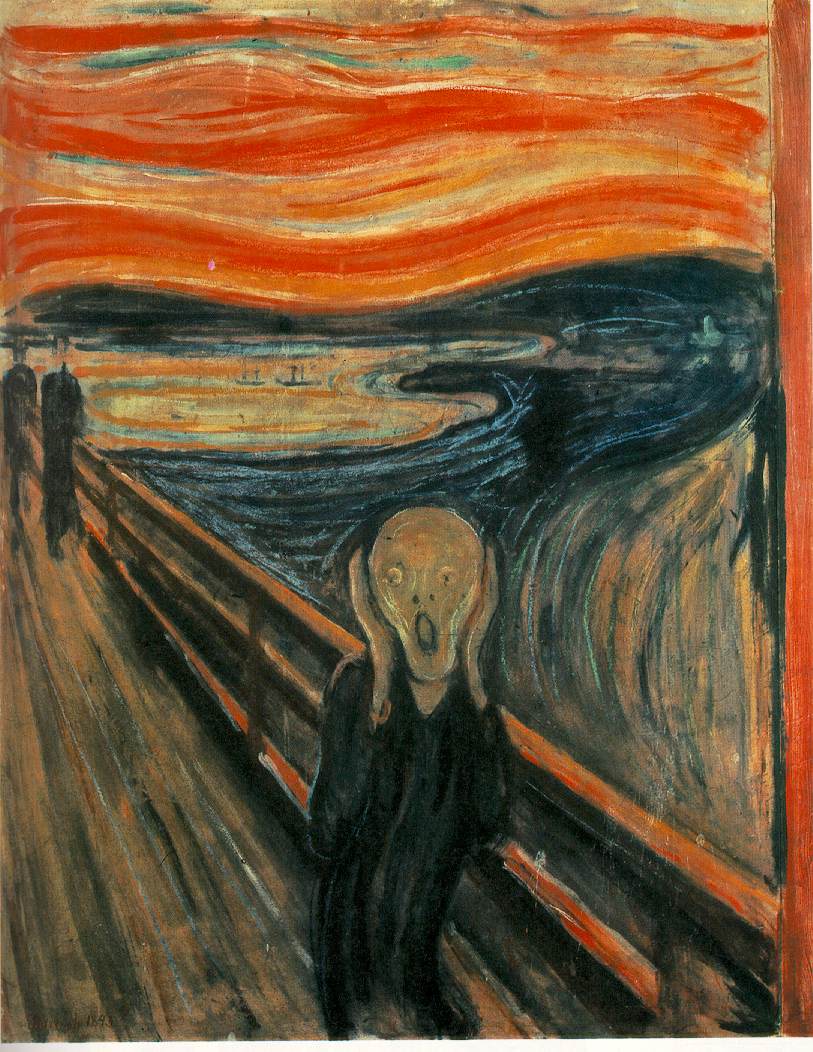
The Scream


Goals:  Students will complete their rough drafts

Students will check their work in  to www.Grammarly
Students will submit their work to Www.turnitin.com
Students will engage in cooperative analysis
(Read, Respond and Reflect/ write about the works of other students)

Reflection

Reflective writing:

The need to think reflectively improves your ability to read critically and analyze ideas presented in class as well as daily experiences. As you write, you clarify your own understanding. The process of thinking and writing reflectively helps you to lay philosophical foundations for all of your creative work.

Thinking reflectively helps you:

Understand the concept of reflective writing
Recognise the benefits of reflecting on your developing an idea or philosophy

Click on the following link to view the painting:

Painting: The Scream
Artist: Edvard Munch

ASSIGNMENT: Study the painting above. Place yourself in the composition and experience the message that the artist, Edvard Munch, is attempting to convey. If you are the person Munch is painting, what have you just experienced? Why are you here? What is Edvard Munch's message? What do you see? Incorporate the following concepts into your essay:

1. Your emotional reaction

2. What emotion is being expressed?

3. How do the colors influence the emotional impact? (Comment on the use of color, direction, brushstrokes used)

Closure Activity: 
At the end of each class, students will evaluate their work. This will promote the ability to self and peer edit. It will also facilitate the goal of positive response. 

Daily Closure Activity:(Click on the appropriate day when completing the closure activity 
Monday, 8/26: Would you describe your responses as figurative or 1iteral? Explain 


Standard - 1.2.11.C: Examine the author’s explicit and implicit bias and assumptions, beliefs about a subject, use of fact and/or opinion, and/or the author’s argument or defense of a claim as related to essential and non-essential information.
Standard - 1.8.11.C: Analyze, synthesize, and integrate data, creating a reasoned product that supports and appropriately illustrates inferences and conclusions drawn from research.

PDFPrint

Mrs. Christian's classes will sign in to www.turnitin.com

Monday, August 19, 2013

Welcome

Bell Ringer: Using complete Sentences, explain one extraordinary fact about yourself.


Composition 9 Syllabus

Contact Information:

Instructor:                           Mrs. Theresa Christian

Email Address:                  tchristian@berwicksd.org

Planning Period:              5

Text and Resource Materials:

            Required Text:

<!--[if !supportLists]--> - <!--[endif]-->Prentice Hall Literature, Grade 9

<!--[if !supportLists]--> - <!--[endif]-->To Kill a Mockingbird by Harper Lee

Course Description:              

This course is designed to provide an opportunity for students to improve upon competencies in reading, writing, speaking, and listening.  Individual attention is given for continued acquisition of reading and writing skills.  Students will read and write frequently and plentifully.  From essays to short stories, writing will be both analytical and creative, with intensive focus on the writing process.  Students will continue to acquire the fundamentals of grammar and will broaden their vocabulary.  In addition, this course challenges students to be open-minded and well-rounded, and to understand the importance of being a life-long learner who is willing to study and understand new ideas, philosophies, and concepts.

Prerequisites:  Application required

PA Academic Standards:

1.1 Learning to Read Independently                                        1.5 Quality of Writing

1.2 Reading Critically in All Content Areas                              1.6 Speaking and Listening

1.3 Reading, Analyzing and Interpreting Literature            1.7 Char. and Function of the English Language

1.4 Types of Writing                                                                        1.8 Research

More information can be found at the Pennsylvania Department of Education website at http://www.pde.state.pa.us


Learning Objectives: 

Upon completion of the course, the student will be able to:

<!--[if !supportLists]-->1.       <!--[endif]-->Become more open-minded and well-rounded, and to understand the importance of being a life-long learner who is willing to study and understand new ideas, philosophies, and concepts. 

<!--[if !supportLists]-->2.       <!--[endif]-->Expand their vocabulary.

<!--[if !supportLists]-->3.       <!--[endif]-->Further develop their critical thinking skills through reading and writing.

<!--[if !supportLists]-->4.       <!--[endif]-->Intensify their study and analysis of literature (both fiction and nonfiction).

<!--[if !supportLists]-->5.       <!--[endif]-->Perfect their writing and communication skills through various types of writing.

<!--[if !supportLists]-->6.       <!--[endif]-->Use computers and other types of media for learning purposes such as for research regarding novel background information and themes. 

Course Outline:

            Marking Period One:

  • Literary Vocabulary Terms
  • Fiction and Nonfiction
  • Short Stories
  • Writing: Research Paper
  • Journal Writing
  • Conflict Writing Project
  • Vocabulary Development
  • Literary Vocabulary Terms

Marking Period Two:

  • Writing:  Informative Essay
  • Types of Nonfiction
  • Poetry
  • Persuasion
  • Journal Writing
  • Literary Vocabulary Terms


                Marking Period Three:

  • Narrative and Reflective
  • Writing:  Reflective Essay
  • To Kill a Mockingbird Vocabulary
  • To Kill a Mockingbird – Webquest and reading
  • To Kill a Mockingbird Vocabulary
  • Writing:  Informative Essay
  • Finish Kill a Mockingbird - reading, testing, and newspaper project
  • To Kill a Mockingbird Vocabulary
  • Journal Writing
  • Romeo and Juliet – reading, testing, and Podcast project
  • Drama Vocabulary Terms Literary Vocabulary Terms


Marking Period Four:

  • Writing:  Persuasive Letter Block Format
  • To Kill a Mockingbird Vocabulary
  • Romeo and Juliet – reading, testing, and Podcast project
  • Poetry:  Reading, writing, and testing
  • Poetry Vocabulary Terms
  • Journal Writing
  • Projects


Classroom Procedures:

1. In the event of a student being absent, he/she is responsible for finding out what work is missed and making it up for the next day. 

              2.  In the event a student is absent the day of a quiz or test, he/she is responsible for making it up the next day. 

                3.  In the event a student is absent the day a project is due, this work must be handed in the next day.  Otherwise, students will receive points off of their project for it being late. 

                4.  Students must come prepared to class and bring everything required.

Assessments:             

Students will be assessed based on the following: class participation, homework, individual and group projects, weekly assignments, essay writing, research, unannounced quizzes and writing assignments, and tests.  Grade is based on a total point system.  Academic integrity is expected at all times.

Grading Policy:                     

Students’ grades are calculated by total points available.  The final is worth 20 percent of your 4th marking period grade.
Passwords:

Periods 3 & 8:
www. turnitin.com

Period 3:
ID: 6766419
Password: period3


Period 8:

ID: 6766432
Password: period8

Grammarly:
www,grammarly.com/edu

**You must use your school email

Please go to "Sign Up" and fill in the information


Closure Activity:
Discuss one goal for the year.

Wednesday, July 31, 2013

Bell Ringer Form

Bell Ringer / Closure Form

Monday, _________
Bell Ringer:


Closure:


Tuesday, _____
Bell Ringer:


Closure:


Wednesday, _____
Bell Ringer:


Closure:


Thursday, _____
Bell Ringer:


Closure:


Friday,_____
Bell Ringer:


Closure:

Wednesday, September 14, 2011

Correct the following:

K. 1. Because Chee’s wife had died, his wife’s parents come to get his daughter.

2. Its the Navajo belief that a girl child belongs to her mother’s people.
Correct the following sentences:
J. 1. Sobs catching in her throat Chee;s sister ran out of the Hogan.

2. Chee felt badly, because he suspected that something had happened to his daughter.

Tuesday, September 06, 2011

I.
Correct the following sentences
1. “Chee’s Daughter” a short story set in the southwest was written by two women.

2. Each member of Chee’s family showed their love and concern for Chee’s daughter.
H.
Correct the following sentences:
A. 1. How exciting it would be to have three wishes.

2. I would wish for happiness health and wealth in that order.
B.
Correct the following sentences:
1. Money was what Mr. White first wished for.

2. 200 pounds was a lot of money to him.
A

Correct the following Sentences:

1. Mr. White examined the monkey’s paw. Asked why it was special.

2. Morris said, It had a spell put on it by a old fakir.

Tuesday, August 30, 2011

The 5 Paragraph Essay Format

The First Paragraph:
• Begins with a topic sentence that introduces a general topic or theme.
• Follows the topic sentence with sentences that narrow the focus of the topic or theme, so that it is less general.
• Introduces the author of the text you are writing about (If applicable. If not, move on to the next bullet point).
• Introduces the title of that text (If applicable. If not, move on to the next bullet point).
• Narrows the discussion of the topic by identifying an issue or problem.
• Finishes with a thesis statement, which must be the final sentence of the introductory paragraph. Students will be graded on the quality of the thesis statement, and whether it is in its proper location—the final sentence of the introductory paragraph.
Three Body Paragraphs:
• Begin with topic sentences that clearly relate to the topic, or issue, or problem, that was identified in the introductory paragraph.
• Sentences that elaborate on the focus laid out in the introductory paragraph, and demonstrate a clear connection to the thesis statement.
• A focus that consistently reflects the focus that was promised in the thesis statement, and an analysis that actually engages in comparison-contrast, or cause-effect, depending on what type of paper the student has been assigned to write.
Conclusion Paragraph:
• Avoid phrases like "In conclusion, . . . ."
• Begins with a topic sentence that clearly relates to the topic, or issue, or problem, that was identified in the introductory paragraph.
• Sentences that make connections with, or revisit, points from the introductory paragraph and the body paragraphs. These points now serve to close the paper's argument.
• A final comment, or intellectual conclusion of sorts that points out the larger significance of your argument.
More About Thesis Statements:
The thesis statement must make clear to readers the focus of the paper, and what the paper seeks to accomplish. This semester, students will write different types of papers, such as comparison-contrast, cause-effect, and an argumentative paper. Each of these different types of papers will have different types of thesis statements.
• For example, a comparision-contrast paper might have a thesis that states: "The purpose of this paper is to compare and contrast . . . ."
• A cause-effect paper might have a thesis that states: "The purpose of this paper is to examine . . . , the cause of which is . . . ," or "The purpose of this paper is to examine . . . the effect of which is . . . ."


An argumentative paper, however, is quite different because the definition of a thesis statement for an argumentative paper is as follows: A debatable claim. Here students must be careful to include a thesis statement that is indeed a debatable claim, as opposed to a statement of fact, and this is where students often experience difficulties that have a negative impact on the grades papers can receive.

Remember that the purpose of an argumentative paper is to persuade readers, so that by the end of the paper, readers agree with the paper's position on the issue at hand. Basically, to prove a statement of fact does not require much persuasion, but to prove a debatable claim requires much persuasion.

For example, if a student is assigned to write an argumentative paper about alternate-fuel techonlogies for cars, here are two example-thesis statements:
• Example of a poor thesis statement: "Biofuels and electric cars are two technologies that present strong possibilities for the future of transportation."
• Example of an acceptable thesis statement: "Biofuels and electric cars are two technologies that present strong possibilities for the future of transportation, but the choice that makes more sense is biofuels because battery technology is not sufficiently developed, the internal combustion engine would not have to be replaced, and the United States already has a fuel-delivery system available to the masses in the form of gasoline service stations.

Above, the example of a poor thesis is indeed poor because it is simply a statement of fact. It is entirely true that "Biofuels and electric cars are two technologies that present strong possibilities for the future of transportation," so a paper with this thesis statement sets out to prove a point that is pretty much of a given; however, a paper that uses the example of an acceptable thesis must prove to readers that biofuels are the better choice for the future. Moreover, the acceptable thesis statement even goes so far as to lay out for readers the three main points that the paper's body paragraphs will cover.


Always Use Academic Prose:
I will grade all your course work, in part, on how well you apply the following requirements to your writings:
• Do not use contractions.
• Do not use first-person pronouns such as "I" "me" "my."
• Do not use second-person pronouns such as "you" "your" "yours."
• Do not engage in personal stories, meaning stories of your own life experiences, or the experiences of friends, family, and so on.
• Do not begin sentences with conjunctions: but, and, or, nor, for, so, yet.
• Do not pose any questions in any assignments. This means, quite literally, not to use questions. Write sentences in the form of statements instead.
• Do not quote the bible or make allusions to religion in any way.
• Avoid any form of direct address to the reader, such as "think about the fact that . . ."
• Avoid too casual of a prose style, such as sentences that begin with words like "well, sure, now, yes, no."
• Do not use phrases such as, "a lot," "lots" or "lots of," which can usually be replaced with one of the following words: many, most, much, often.
• Do not use exclamation points, for they are almost always unnecessary.
• Periods and commas should be inside of quotation marks, but other forms of punctuation go outside of quotation marks.
• Do not use the word "okay" when words like "acceptable" could be used instead.
• Do not use the word "nowdays," "nowadays," or any slight variation thereof.

Sample essays: http://www.essay-writing-tips.com/samples/sample-of-5-paragraph-essay-on-astronomy.html


Essay types: http://essayinfo.com/essays/5-paragraph_essay.php


Wednesday, August 24, 2011

Daily Activity:
Tuesday, 8/30- Click to view sentences

Goal:
Students will discuss organizational strategies

Students will understand what nouns are and how they are used
Students will be able to identify compound nouns

Plan:
Students will read their advice paragraphs


1. In small groups, students will present their "Advice" paragraphs
2. Students will discuss organizational strategies and evaluate paragraphs
3. Students will read about nouns on pg 341-42 in their Grammar and Writing textbooks
4. We will review and discuss nouns using practice exercises from the text
5. If time allows, students will complete and review workbook exercises on pages 1 and 2

CLOSURE ACTIVITY:
At the end of each class, students will evaluate their work. This will promote the ability to self and peer edit. It will also facilitate the goal of positive response.

Daily Closure Activity:(Click on the appropriate day when completing the closure activity.
Tuesday, 8/30 - Use two nouns and two compound nouns in ONE sentence.
Monday, 8/29
Correct the following sentences:

1. elements of a short story include plot setting and characterization.

2. Some people think that james Joyce wrote the better stories of all.


Friday, 8/26

Correct the following Sentences:
1. Edgar allan poe was the first writer to view short storys as a separate for of literature.

2. Many of Poes ideas were published in a book entitled The Philosophy of the Short Story.
Thursday, 8/25

Correct the following sentences:
1. Most Short Stories has a limited number of characters.

2. I enjoy short stories because they can be read in one setting
(2 mistakes; 1 is active voice)

Monday, August 22, 2011

Bell Ringer

9/6 Tuesday

Daily Opening Activity:
1. Get your composition notebook.
2. Make sure your name is on the top left had margin on each page
3. Date each entry. UNDERLINE the date.
4. Correct two sentences each day.

Correct the following sentences:
1. The Three Wishes is an old German folk
tale from long ago.
2. In the tale, a woodcutter and his wife have
three wishes but they waste them.
Bell Ringer
Monday, 9/5

Daily Opening Activity:
1. Get your composition notebook.
2. Make sure your name is on the top left had margin on each page
3. Date each entry. UNDERLINE the date.
4. Correct two sentences each day.

Correct the following sentences:
1. In an arabian tale, a genie grants three
wishes to a mischievious boy named
Aladdin.
2. Those there wishes bring Aladdin great
wealth.
Bell Ringer:
Friday, 9/2

Daily Opening Activity:
1. Get your composition notebook.
2. Make sure your name is on the top left had margin on each page
3. Date each entry. UNDERLINE the date.
4. Correct two sentences each day.

Correct the following sentences:
1. Money was what Mr. White first wished for.
2. 200 pounds was alot of money to him.
Bell Ringer
Thursday, 9/1
Daily Opening Activity:
1. Get your composition notebook.
2. Make sure your name is on the top left had margin on each page
3. Date each entry. UNDERLINE the date.
4. Correct two sentences each day.

Correct the following sentences:
1. Mr.White examined the monkey's paw.
Asked why it was special.
2. Morris said, It had a spell put on it by a old
fakir.
Wednesday, 8/31

Daily Opening Activity:
1. Get your composition notebook.
2. Make sure your name is on the top left had margin on each page
3. Date each entry. UNDERLINE the date.
4. Correct two sentences each day.

Correct the following sentences:
1. "The Monkey's Paw" is set in the home of
Mr and Mrs White.
2. Other characters in the story are: Herbert
and sergeant major Morris.
Tuesday, 8/30
Daily Opening Activity:
1. Get your composition notebook.
2. Make sure your name is on the top left had margin on each page
3. Date each entry. UNDERLINE the date.
4. Correct two sentences each day.

Correct the following sentences:
1. The Monkey's Paw was published in 1902,
the story was made into a play a year later.
2. The author of the story was born in London
England.

Saturday, August 20, 2011

Wednesday, 8/24
Daily Opening Activity:
1. Get your composition notebook.
2. Make sure your name is on the top left had margin on each page
3. Date each entry. UNDERLINE the date.
4. Correct two sentences each day.


Correct the following sentences:
1. You can make predictions about a story by thinking about you're own experiences!
2. Besides using personal experiences you should also look for story clues.

Friday, May 30, 2008

Final Journal Day

TODAY IS THE FINAL DAY TO TURN IN MISSING JOURNALS. PLEASE BE SURE TO INCLUDE A POST-IT-NOTE ON THE FRONT OF YOUR JOURNAL INDICATING THE JOURNALS TO BE GRADED.

Students should create a two page journal on the following prompt:

Reflect on your school year. What were the high points? The low Points? How did they change/ influence your life?

Or

With 5 half days to go, why can't you wait for summer vacation?

Or

Students may create a two page journal on an appropriate topic of their choice

Monday, May 12, 2008

Students will create Power Point presentations

Monday, May 12- Monday, May 19 (Create Power Point Projects)
Tuesday, May 20-Friday, May 23 (Power Point Class Presentations)

Students will create a 12 slide Power Point presentation

Requirements:
-Students will create a 12 slide presentation (This does not include your title page or your works cited page at the end of the presentation)
-Presentations should be 4 minutes long (Min.)
-Presentations must be creative.
*The slides should be creative and contain a theme
*Students should present their material in a creative manner (EX. Dress like their
character,bring information to pass out to the class, create an overview sheet for the class, play music or
video clips)


Restrictions:
-You may not read from note cards or your slides during your presentation
-Your slides must be creative.......More than a photo or a group of words
-You may use 3 small note cards during your presentation; however, you may not read from the cards.


Tuesday, May 20-Friday, May 23
Students will present their Power Point Project utilizing the Smart board

Click the link below to view rubric for this project:
Power Point Project Rubric
http://rubistar.4teachers.org/index.php?screen=ShowRubric&rubric_id=1474890&


Posted by journalism1 at 6:40 AM

Friday, May 09, 2008

Journal Day

Today you will write a two page journal on the following prompt:

If you won $10million in the lottery, what would you do?

or

You may create a two page journal on a topic of your choice


Have a marvelous weekend!!
19 days of school left!!!

Tuesday, May 06, 2008

Wednesday, May 7, 2008

Journal Day

Students will create a two page original journal.

Students may use the following prompt
or
Students may create an original entry

Prompt:

Write out your goals--for the world, for your lifetime, for next year, or for today. What one step could you take to start you towards achieving that goal?
May 1-May 5
Students will write their research papers

-Mrs. Christian will conduct individual checks

May 6- All research papers must be ready to be peer editid by three people

May 6 - All Research papers are due. NO EXCEPTIONS

Friday, April 25, 2008

Journal Day

Today is Friday 4/25 and that means today is a Journal Day. You will have the entire period to write in your journals. You will need to complete 2 full pages of writing by the end of the period. Make sure your writing sticks to the prompt. I will be checking to make sure that everyone is working on the prompt.

Here is today's prompt:

Thoreau said, “Simplify, Simplify.” If you could simplify your life, what would you change and how would you change it?

or

Write a 2 page journal on the topic of your choice


Keep it clean. (no racy topics, drugs, alcohol, etc.)
Be specific.
Use examples.
Be creative.
Have fun.


Tuesday, April 22, 2008

April 22, 2008 - April 30, 2008

Everyone should be writing their research paper today. Be sure to use the resources to help support these papers. Everyone needs to use at least 4 different direct quotes and 4-6 different paraphrased/ cited documentation in their paper. Remember not to plagiarise. Cite everything pulled from another authors' work.

I. Tuesday, April 22, 2008
A. Students will create a working outline (Motivator, Blueprint, Thesis, Body
Sections (Not 3 body paragraphs--this report is more extensive), Conclusion)
B. Students will organize their notes according to the various sections of
their reports
II. Wednesday, April 23- Thursday, April 24
A. Students will begin to write their rough drafts NOT utilizing notebook
B. Once the basic format of the paper is established, students will begin to
incorporate research into their papers
III. Friday, April 25, 2008
A. Journal Day
B. Students will complete a two page original journal...See journal blog
C. Paper check....Mrs. Christian will monitor your progress on your research
paper.
IV. Monday, April 28 - Wednesday, April 29
A. Students will continue working on their research papers
B. Students will have graded checks during these days
V. Thursday, April 30, 2008
A. Students will peer edit and correct their rough drafts
B. Students will compile and turn in completed research papers NO EXCEPTIONS!!
Please make arrangements for your paper to be turned in at this time

PAPER SPECIFICATIONS:
1. 4-6 pages
2. Clearly supported thesis and blueprint
3. Title page
4. Works Cited Page
5. Bibliography page
6. Proper citation requirements...see minimal requirements stated above
7. Typed: Times New Roman, 12 pt. font. Double spaced
8. For an example of proper paper format refer to the Diane Hacker example on the Bucknell website.

*Any student who did not receive a 96/96 on the research notebook is REQUIRED TO RESUBMIT!!

Academic Content Standards:

1.5.11 d WRITE WITH A COMMAND OF THE STYLISTIC ASPECTS OF COMPOSITION
1.5.11c WRITE WITH CONTROLLED ORGANIZATION
1.5.11a WRITE WITH A SHARP , DISTINCT FOCUS
1.5.11 b WRITE USING WELL-DEVELOPED CONTENT APPROPRIATE FOR THE TOPIC

Monday, April 14, 2008

Monday, April 14- Friday, April, 18

Students are taking notes for their research projects.

Students are required to have notes from 12 sources in their notebooks. Notes MUST consist of a variety of direct quotes as well as paraphrased material.

Be sure to have your notebook set up in required format. (number sources; bibliography entry on left page and notes on the pages that follow)

You will be required to use a min. number of direct quotes and paraphrased items in your final paper. Please be sure to include page numbers.

Friday, April 11, 2008

Journal
Friday, 4/11/08
Write a journal using the following prompt:

Create your own imaginary best friend. What does he look like? What's his zodiac sign? What are her likes and dislikes?
or

Write two pages on the topic of your choice

1.4.11D Maintain a written record of activities, course work

Wednesday, April 09, 2008

Library Days

Tuesday- Thursday

All comp. I classes will meet in the library

Research Requirements:

1. Students must have their research notebooks EVERY day. (There will be daily checks)

2. Students must create bibliography/ works cited entries and notes for 12 sources

3. Four (4) sources must be tangible.........actual books, magazines, newspaper articles, etc.

4. You may use more than 4 tangible sources.

5. Taking notes means just that. I don't expect to see four words for each of your notations.

You must provide ample notes.

**Include quotes around direct quotations
***Be sure to paraphrase
****If there is a page number, include it!!

Have fun, stay on your topic and organize!!

Monday, April 07, 2008

Today we will begin our research.

Using the Power Library and the approved online sources, we will begin our official Notebooks.

1. Today, I will check notebooks
2. Sign up for a topic
3. Begin research

Friday, April 04, 2008

Journal Day

1. Option A: Write a journal on the following prompt:
If you could invent something to help mankind, what would it be? How would it help? How would it be useful to mankind? Why would you invent this?

or

Option B:


Write a two page journal on the topic of your choice

ALL JOURNALS MUST BE TURNED IN AT THE END OF CLASS.


1.5.11 b WRITE USING WELL-DEVELOPED CONTENT APPROPRIATE FOR THE TOPIC

Wednesday, April 02, 2008

Tuesday, April 01, 2008

PRE-RESEARCH

Tuesday- Thursday:

Homework Check: Subject check
(Students were assigned to list three notable people for research. The person must be well known and reputable)

1. Students will use the online databases to explore each possible topic
2. Students will not take notes, but they will keep a listing for each person
3. Students will read articles (this means you can't just look at blue links, you must actually read the articles to make sure there is suitable information available for each subtopic for each person)

4. Students will notate each area that is appropriate for research. EX: Pres. Bush: Family
(Students will take notes on the areas of his family life. What topics have ample research)

5. On Thursday, we will take our lists and select a person for our research. Students will also select their three areas for their blueprint.

**If you completed this PRE-RESEARCH step correctly, you won't experience any problems finding research on your subject

Monday, March 31, 2008

Researching Basics

Our librarian, Miss Hoffman, will join us today.

Today we will be working with a few tools that are accessible within the lab / school. Be sure to pay attention to everything. You are going to discuss a lot of information. You will be working with Nettrekker, SIRS, Newspaper source and AP Multimedia.

If at any points there are any questions, do not be afraid to raise your hand and ask.

Nettrekker will require a password.

Username: Berwickhs
Password: Library

Friday, March 28, 2008

Friday, 3/28/08

Journal Day

Today you have the option of writing a journal on the following prompt:

List 7 remarkable experiences that have happened in your life. Next, write about each one.

Or

Complete a TWO page free-writing journal

Have a wonderful weekend!!

Thursday, March 27, 2008

Today we are going to complete a lesson on There, They're and Their

1. Students will review the uses of these words
2. Students will complete a quiz


**Three paragraph essay/ research assignments were due yesterday

Tuesday, March 25, 2008

Today we will add research to our three paragraph essays

1. Using the information that you marked into your favorites, you will begin to take notes
-We will review the note taking process.

2. Once you have completed this step, we will incorporate one direct quote and one paraphrased section into your paper. *Please note that we are not adding exceptionally long direct quotes.

3. As you are adding research into your paper, you will create a " Works Cited" page.

-Remember to double space your WC page, Center the words " Works Cited " on you paper
-Be sure to place each entry in alphabetical order
-Use proper indention/ form

-You will turn in your notes, outline, paper and works cited page on Wednesday, March 26.

1.4.11B Write complex informational pieces
1.5.11A Write with a sharp, distinct focus

Tuesday, March 18, 2008

Today we will add research to our three paragraph essays

1. Using the information that you marked into your favorites, you will begin to take notes
-We will review the note taking process.

2. Once you have completed this step, we will incorporate one direct quote and one paraphrased section into your paper. *Please note that we are not adding exceptionally long direct quotes.

3. As you are adding research into your paper, you will create a " Works Cited" page.

-Remember to double space your WC page, Center the words " Works Cited " on you paper
-Be sure to place each entry in alphabetical order
-Use proper indention/ form

-You will turn in your notes, outline, paper and works cited page

1.4.11B Write complex informational pieces
1.5.11A Write with a sharp, distinct focus

Monday, March 17, 2008

Journal Day
March 17, 2008

Write a journal entry using the following prompt:

Since today is St. Patrick's Day, write about anything lucky: Your good luck charms or traditions, your luckiest moment, a person who is very lucky in your life.

OR

Write two pages on the topic of your choice

1.4.11D Maintain a written record of activities, course work

Friday, March 14, 2008

Journal Day

Students can either write a two page "free choice" journal

or

Students can respond to the following Journal Topic:

It is important to "Think before you speak." Many times, people should refrain from speaking on impulse.

Discuss this situation. Do you agree with it? Can you think of a situation or story to support this idea?


Example:
-I believe this is especially true when people are angry. I think it is essential to give yourself an hour to cool off before responding to someone who has provoked you. If it involves something really important, give yourself overnight.

Monday, March 10, 2008

Monday and Tuesday - research

1 Using the following link, we will explore the elements of a research paper.

http://www.bucknell.edu/Documents/ISR/mla.pdf

http://dianahacker.com/pdfs/Hacker-Daly-MLA.pdf


2. We will discuss the following:
-the purpose of citing within a paper
-Direct quotation and paraphrased work
-The WORKS CITED AND BIB. PAGE
-The form of a research paper
-Where to find information
-Citing information

Links to electronic citing:

http://www.noodletools.com/

http://www.sonofcitationmachine.net/

Question/ Answer link:
http://mtsu32.mtsu.edu:11178/171/tips.htm

1.4.11B Write complex informational pieces
1.5.11A Write with a sharp, distinct focus

Friday, March 07, 2008

Friday, March 7, 2008

Journal Day: (20 Points)

When I am famous...

"In the future, everyone will be famous for 15 minutes" - Andy Warhol

What does it mean to be famous. Would you like to be famous? What would you like to be famous for?

Write:
An account of what you would like to be famous for, and why.

A diary, written as if you were famous in the future. What things do they have to do?

Everyone must write on this topic

1.5.11A Write with a sharp, distinct focus

Tuesday, March 04, 2008

Tuesday, March 4, 2008

Today we are going to write a three (3) paragraph essay.

-Select a topic with which you are familiar
-Make sure it is a topic that we can research at a later date.

Opening paragraph:
1. Begin with a motivator
2. Brief background/ relevant information that will enhance your opening paragraph.
-This information must be RELATIVE to your thesis statement
3. Thesis statement and 1 part blueprint

Paragraph 2
1. Begin with a transition/ topic sentence. Don't forget to incorporate the blueprint idea.
2. Use specific examples/ details
3. Make sure you are using valid points that support your thesis

Paragraph 3
1. Conclusion

Requirements: Paragraphs must have a minimum of 6-8 relevant sentences
No first or second person
No slang
Must be written using complete sentences
Avoid words such as "stuff" and "Thing"

1.5.11A Write with a sharp, distinct focus

Monday, March 03, 2008

Goal: Students will understand how to correctly use quotations in their writing.

1. Students will review correct quotation use.
2. Students will use the smartboard to share examples with the class.
3. If finished early, students will conference with the teacher regarding their timed informational prompt.

Links:
Review: http://www.grammarbook.com/punctuation/quotes.asp
Quiz: http://www.grammarbook.com/grammar_quiz/question_marks_1.asp